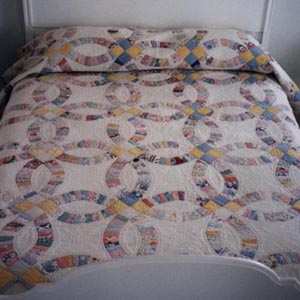
Above quilt is from The Wisconsin Museum of Quilts & Fiber Arts
This is one of those never ending topics as you can literally go "OMG LOOK AT THIS FABRIC I FOUND!!!" and you'd have a massive post all of its own. So quilting. I'll do a bit of background on myself and quilting for now, as well as a bit of info about quilting, and maybe some tips and the basics etc.
I haven't been quilting very long - I am a beginner. Sewing, however, my mom has had me doing since I was old enough to hold a plastic needle without taking my eye out, and stitching with yarn on that plastic canvas stuff. So probably since I was 4 or 5, and shortly after that I would have advanced to mucking around with real needles and thread on scraps, learning how to actually do stitches. I started doing stuff like crossstitch and embroidery around age 8, and shortly after started progressing into learning how to use the sewing machine and sew stuff from patterns. My mother was taught sewing, quilting etc by her mother and grandmother, so I'm probably a 4th generation sewer/seamstress at least. Quilting however, is something I'm just really getting into since my mom hasn't done a lot since I was younger. Now we'll move on to quilting.
What is quilting? A lot of people see me sewing and go, "Oh, are you quilting?" to which I give them an evil death glare and go, "No, I am sewing. This is a shirt." Quilting =/= sewing. Well, okay, it does, but it doesn't. You have to sew before you can quilt. Quilting is when you have a quilt top/top layer, then batting/insulation, then a backing/bottom layer, and you are sewing them together to get a design/hold the batting in place, and it makes it kind of puffy/defined. Quilting can be done by hand or machine, although a lot of people prefer hand quilting when they go looking, but the majority of non-sewers haven't a clue what the difference is. To me the difference is that with machine quilting the stitches are closer together, and in hand quilting they're a bit farther apart, resulting in spaces between the stitches. But again, that's not something a lot of people notice, and only happens because of how a sewing machine works. I think... lol.
As for types of quilts... if you can dream it, then sew it together or appliqué it, you can do it. Designs range from traditional, to contemporary, to an art medium, to anything between these. There are traditional patterns like a log cabin or a wedding ring, or a Dresden plate, and there are newer quilts used as art mediums - an example would be a quilt I saw online (and can't locate again *sad face*) of a solider in uniform handing a woman in funeral attire a folded U.S. flag that, due to the quilt, I am assuming came off the coffin of another soldier. A lot of quilt blocks also have multiple variations, so if you go looking for one and keep finding the "wrong" thing, look again, because it might be a different pairing of two patterns to make a new design, or the same pattern but different ways of putting the blocks together in a larger design (see this different log cabin quilt from the link above...) Traditional quilting is sewing pieces of fabric together to get the design - no matter how small or awkward the piece. Appliqué quilting is where you make a background and then sew shapes cut out of fabric on top of the background, and then go around and do the quilting, or the appliqué process is the quilting. Not all quilts are quilted by sewing. There are also tied quilts. These days there are two forms of tied quilts. One is like the traditional 3 layers of the quilt and then you take pieces of yarn or ribbon or something and put it through the layers, bring it back up, and tie it. The other way is to actually have quilt blocks (I'll get to these in a bit), typically made of non-fraying fabric like fleece, and having the edges cut so you can tie the blocks together. Some quilts are actually just one type of fabric, plain or patterned, possibly the same for both the top and the backing, and the design done in the quilting is the artwork of the quilt.
A quilt block is pretty much exactly that - one block of a quilt top. Or for those with no quilting knowledge, one complete section/repetition of the pattern that makes the whole design of the quilt top. Sometimes the blocks look kind of ugly by themselves, but make a nicer pattern once all the blocks are put together in the quilt. Take this image for example - it is 4 blocks wide by 5 blocks long. A block by itself would look rather ugly or unappealing, but together it makes another pattern that is highly appealing. Quilt blocks can be pieced together (different pieces of fabrics sewn together) or they can be a square of fabric with emrboidery or cross stitch on them, etc. Quilt blocks are usually squares between 12 and 18 inches in size when finished, but custom sized blocks or other designs can be bigger or smaller depending on what the person wants. The designs for quilt blocks range from highly simple (as in large, plain squares of fabric sewn together OR a postage stamp quilt of very very small squares of fabric sewn together) to blocks made up of many, many pieces with different shapes. My advice with these is start with simple stuff, and work your way up, or you can start harder, it's all really the same in the end. You can find lots of free patterns on the internet, or you can buy them at local stores etc, or make your own. You can also buy quilt top kits that come with the fabric precut for a certain size quilt etc. Batting comes in different thicknesses, different fibres and different sizes. Some batting comes in small "craft size" sheets (usually only meant for stuff like table runners, or wall hangings, maybe a crib or lap quilt), some comes bagged, sized to make one quilt, and other batting comes on giant rolls at the stores and you buy just enough for one quilt. Backing is usually just one type of fabric that is put on and bound and quilted with the top. You could do reversible quilts and technically have two tops, I've never done one of those except for baby size, but I did it very simply, and still found it was hard to pick a design to quilt because you usually do something pertaining to the pattern in the fabric/shapes in the blocks.
Some quilts can be made out of panels purchased at the store. These are usually designs printed into fabric, and come in varrying sizes, and usually make a baby sized blanket/wall hanging or smaller. These also usually have backing fabrics that match in the store. Basically with these you slap 'em together with some batting and quilt around stuff in the designs.
This is where we start getting into the tips and basics etc.
Fabric selections of today help a lot in new designs with all the patterns, textures and designs available. You can certainly mix and match types of fabric, it's all up to you. Some designs are easier to mix and match fabrics, and usually people will go with a quilting cotton. Quilting cotton, in my experience, is a bit heavier of a cotton. Broadcloth also works, it's a bit lighter, and I personally have found I don't enjoy mixing the two, mainly because with use they won't wear evenly, but I will do it depending on what kind of look I am going for. The log cabin quilt on my bed is probably over 100 years old, and it's shredding (which is why I'm working on a new quilt) but it's comprised of many types of fabric, the cottons and silk-like thinner types being the first to wear. Fabric types would also depend on the use - while I prefer softer fabrics like cotton or fleece for baby blankets (not receiving blankets though, those are cotton flannel), my mother likes to use a heavier polyester for simple crib quilts (where the tops are just squares sewn together) so that it will take quite a beating and lots of washing - we still have one from my brother or sister I think, or maybe it's mine, but either way, it's been kicking around for at least 20-30 years. Fabric isn't cheap - I know currently I've spent probably $100-$150 or more on fabric for my quilt top alone - and going to specialty quilting fabric stores is usually even more costly. Cheaper stores will sell fabric for about $8-$10 per meter/yard for quilting cottons and broadcloth (Wal-mart possibly even cheaper lol), but the more expensive stores will charge between $13 and $20 per meter/yard for quilting cotton/broadcloth. Also look out - a non-speciality store will sell you under 1/4 of a meter/yard, but a speciality store will usually say the smallest size they can sell you is a "fat quarter." SO, what is a "fat quarter"? Fat quarter: A piece of material measuring about 18" x 22". Traditional quilting fabric is 44-45" in width. A yard is 36" (a meter is 39".) A regular quarter yard is 9" by 44"; a fat quarter is made by cutting a half yard (18" x 44") in half in the direction of the length (splitting the 44") instead of the width (splitting the 9"). Stores also susually sell bundles of fat quarters that compliment each other so that sewers and quilters can just grab one of those and use them. Apparently there is also something called a "fat eighth" but I'd never heard of it until I found this website... http://www.wasiq.org/wasiqterms.html
You can buy fabric online as well, I haven't done that(yet), but just make sure you know how much you will need BEFORE you order! Nothing is more annoying than running out of fabric and then getting to the store or whatever and finding there isn't any left, and you're trying to find something similar or complimentary. My rule of thumb is always buy a bit more than you need - not A LOT more (I make that mistake all the time) but usually a half meter of extra (or if you think you may need a lot, or are having a bad day, an extra meter. Occassionally if there's only 2 meters left on the bolt I will buy all of it just to be safe.) Worst comes to worsse you have to find something else to make hehe.
So some more basics/tips in no real order...
ALWAYS ALWAYS ALWAYS PRESHRINK YOUR FABRIC! ALWAYS!!! Mom and I were in a fabric store one day and a woman was telling the employee about how she NEVER preshrunk fabrics she used. We wanted to kill her and call her crazy. She does sewing for a living and she never preshrinks her fabric because "time is money." Time may be money, but when your clients may or may not take the time to listen to your care instructions of "Wash with cold, hang to dry" and their clothes shrink every time they get them from you, do you think they'll come back? No. You don't even have to WASH wash it first, just get it wet and throw it in the dryer. You can do that while you work on some other project. And no, washing/wetting it, then hanging it to dry usually will NOT shrink it. It must go in the dryer, and it must have SOME heat. I don't reccomend using the dryer for drying stuff like quilts or bedspreads or comforters after they're done though, because it takes a toll on the batting/filling. Not unless you use air dry or the delicate cycle. Now, not all fabrics shrink, and not all can be put in the dryer. Read the label on the bolt of fabric, or ask an employee if you're not sure. Some fabrics are dry clean only - like silk. Usually for me, if it's shiny the rule is no dryer. Also be careful with stuff that has coatings (this is another point as well.) Stuff like bridal satin may be able to go into the dryer on delicate or air dry, but usually I'll just wet it and hang to dry to get dirt and protective coatings off it. And avoid putting stuff with plasticy coatings (and for sure not pleather/vinyl) into the dryer because it ruins them. Same goes for fabrics with metallic/pearlized touches, or any real embellishment - ex. a cotton blend with stars that have metallic gold accents. Dryer heat is not their friend really. Same with screened on prints. That is what causes them to crack etc. Air dry, or delicates cycle!
Never/rarely use a dryer on a setting higher than air dry/delicates with anything that is sewn with invisible thread because this is usually plastic. Plastic + heat = melty melty.
Cotton is one of the WORST fabrics for shrinking, so ALWAYS preshrink cotton and cotton blends.
ALWAYS read the washing instructions for fabrics. Some things treated to be flame retardant or whatever, have specific washing instructions so that you don't compromise the coatings.
ALWAYS straighten fabric. Now, there's a few ways to do this, but the most common is ripping the fabric. Yes, that's right, I said it, ripping. Most fabrics that rip (I've had a few exceptions) will rip with the grain line, therefore becoming straight. Of course you always occassionally get those fabrics that rip oddly, or the ones with prints that make the fabric look crooked (or a combination of the two...) Now for stuff like bridal satin etc that WON'T rip, you should pull out a thread or two a short distance from the cut edge and then cut the fabric on the resulting line. Some fabrics should be "straightened" by cutting with the pattern on the fabric. Other fabrics, don't even bother trying to straighten lol. For quilting, edges should ALWAYS be straight before cutting stuff like squares and rectangles - I personally will rip these pieces the right size and then cut them into the other side needed. Some fabrics will only rip one way, others will rip both. It's usually a good idea to rip the edges that were cut/ripped at the store. DO NOT rip along the selvage edge of the fabric (unless it actually rips that way, but usually most fabrics won't.) To straighten by ripping simply cut about 3/4" into the fabric about 3/4"-1" away from the edge and then rip. If it only goes about half way and it ends because you've ripped it straight to that point - it happens if the fabric has a curved shape to it from cutting, very similar to this ) - go back to the top, and try again, about 1/2"-3/4" from your new edge. Do this to both ends of the fabric.
Be warned that some stores rip fabric - leaving a straight edge - and others will cut their fabric - meaning you need to straighten it at home. Now usually it's not toooo bad, but I have had it where I once lost almost half my fabric and considered myself lucky that I didn't need a lot.
A yard is 91.44cm or 36". A meter is 100cm or 39". Fabrics are usually around 45" wide, or 60" for some. Some can be narrower, some are wider.
Take your time picking out quilt patterns, etc. This is a big investment etc.
There are tons of toys/tools for quilters. Fancy rulers, fancy sewing machines, tools to make certain types of stuff for quilts/crafty decor sewing projects (seriously I found a fat cats ruler tool! Srsly!)
A good way to protect your fingers from getting stabbed by the needle - especially if you have issues wearing thimbles like I do - my mom paints her finger tips with some nail polish, then let's it dry fully and then starts her quilting. You don't have to worry about it getting lost, falling off, or hindering your sewing because it just forms a protective layer over your finger. Of course it won't stop a good forceful stabbing motion of a needle, but it'll protect against most minor pokes.
If you can't sew and you plan on buying a quilt - $300.00 is a GOOD price/deal (or a poorly done quilt...) at the low end, but really, you can expect to pay into the thousands of dollars range for quilts.
Also, if you're quilting with others, or by yourself, or are buying a quilt - check the stitching. My mom was quilting with a bunch of older church ladies at one point when my brother had a janitorial job at this church, and the stitches weren't even, they were big, they were kind of sloppy and all over the place. A lot of people don't think this matters, but it does. Which is probably why so many people have changed to using sewing machines to do the quilting lol.
I think that's it for now. Everything else can go into other posts etc, and this is getting long lol. Also, you can leave comments if you want me to go over anything else :)